Understanding Financial Hardship in Southington
March 24, 2026
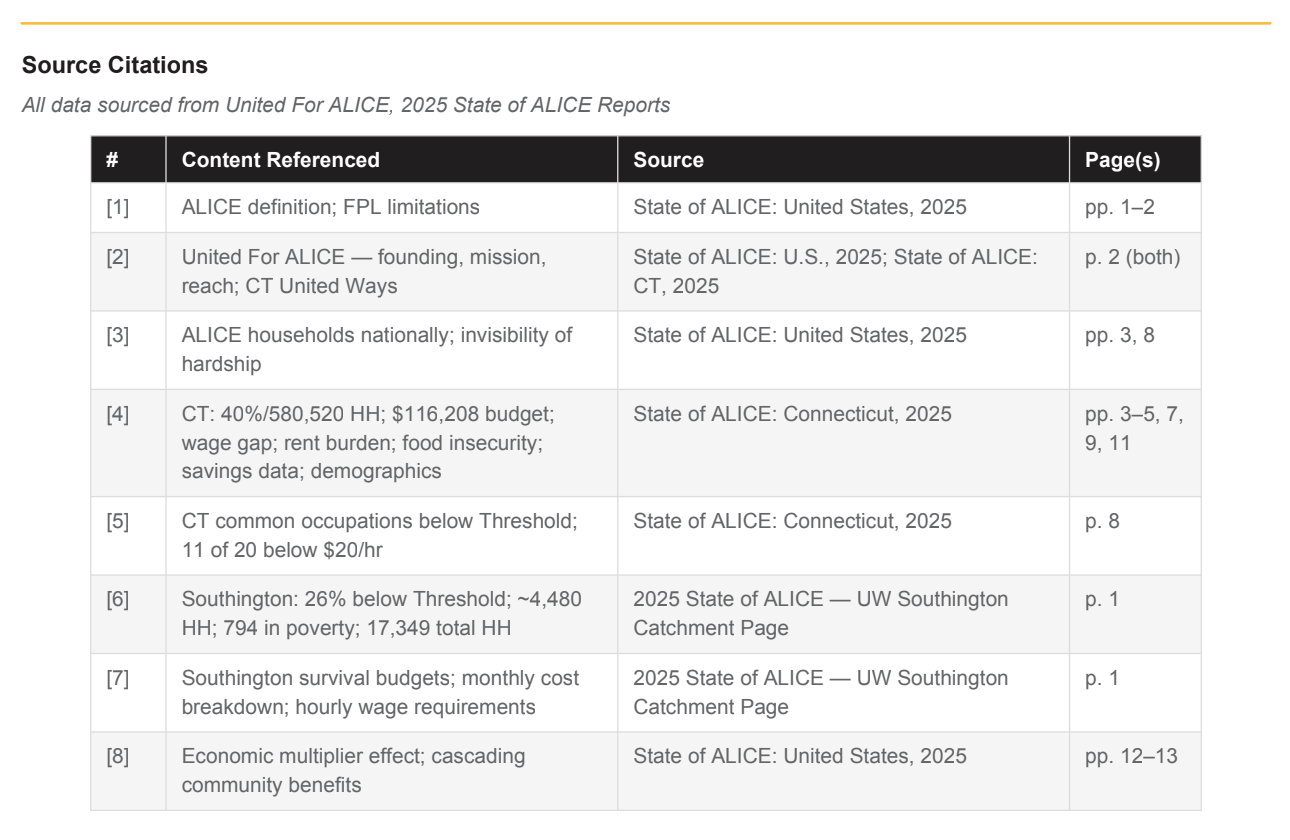
Source: United For ALICE, 2025 State of ALICE Reports
Think about the people who keep our community running every day — the home health
aide checking in on an elderly neighbor, the cashier at the grocery store, the delivery driver
making sure packages arrive on time. These are people with jobs, people put in effort,
people who contribute. And in many cases, they are people who still can't make ends meet.
It's a reality that doesn't always show up in the headlines. But the numbers tell a clear story — and it's one that every Southington resident deserves to understand.
The Poverty Line Doesn't Tell the Whole Story
When most people think about financial hardship, they think about poverty. But the Federal Poverty Level (FPL) — the official government benchmark — was developed in the 1960s and hasn't kept pace with the true cost of living. It doesn't account for where you live, what childcare costs, or what it actually takes to keep a family stable and healthy today. [1]
As a result, millions of households fall through the cracks. They earn too much to qualify for public assistance, but not enough to cover their basic needs. They are what researchers call ALICE.
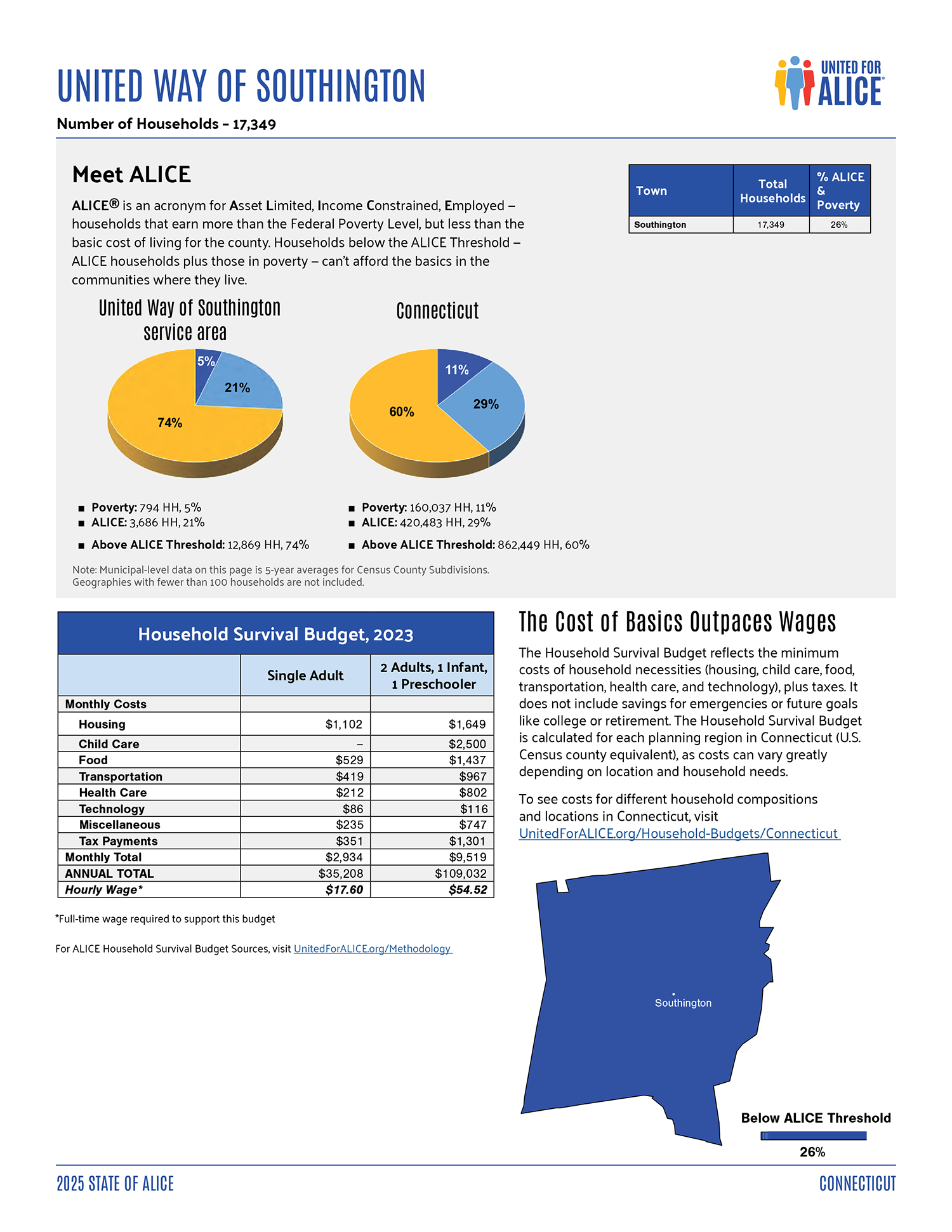
ALICE stands for Asset Limited, Income Constrained, Employed. ALICE households earn above the Federal Poverty Level — but not enough to afford the basics in the community where they live. Housing. Food. Transportation. Health care. Child care. Technology. These are not luxuries. They are the minimum requirements for a stable life. And for ALICE households, they are often out of reach. [1]
Households below the ALICE Threshold — ALICE households combined with those in poverty — are forced to make impossible choices. Pay the electric bill or repair the car. Buy groceries or fill a prescription. These are not hypothetical trade-offs. For hundreds of thousands of families across Connecticut, they are everyday reality.
What This Means for Southington
Southington is not insulated from these pressures. According to the 2025 State of ALICE data, 26% of Southington households — approximately 4,480 families — fall below the ALICE Threshold. [6]
The numbers behind that percentage are sobering. A single adult in Southington needs $35,208 per year just to cover basic necessities — the equivalent of $17.60 per hour, full-time. For a family of four with two adults and two young children, that number climbs to $109,032 per year, or $54.52 per hour. [7] That is not a comfortable life. That is not savings or retirement or a family vacation. That is the floor — the minimum required to simply get by.
To understand what that budget actually looks like, consider what a Southington family of four must cover every single month: $1,649 in housing. $2,500 in child care. $1,437 in food. $967 in
transportation. $802 in health care [7]. That's over $7,300 in essential monthly expenses before a single unexpected cost arises. There is no room for a broken appliance, a missed shift, or a medical bill. There is no cushion. In 2026, with the onset of inflation and other economic factors, budget needs for Southington families have increased.
For a single adult, the math is equally unforgiving. At $17.60 per hour, a full-time worker earning minimum wage in Connecticut — currently $16.35 — doesn't even clear the baseline. They begin the month already behind. [7] And of Southington's roughly 17,349 households, 794 live below the Federal Poverty Level — families for whom even the survival budget described above is far out of reach. [6] These are the households most likely to be navigating multiple crises at once, with the fewest resources to do so.
These Are Our Neighbors
It is easy to picture financial hardship as something that happens somewhere else, to someone else. The ALICE data challenges that assumption directly. ALICE households exist in every neighborhood and represent every demographic group. They are the people stocking shelves, delivering packages, caring for children and the elderly, preparing meals, and cleaning offices. They are working. They are contributing. And they are struggling — often invisibly. [3, 5] That invisibility is part of the problem. When hardship doesn't look like what we expect, it goes unaddressed. The ALICE framework exists precisely to make it visible.
United Way of Southington's Role
United Way of Southington exists because these challenges are real in our community.
Our work across four focus areas — Youth Opportunity, Financial Security, Healthy Community, and Community Resiliency — directly addresses the pressures that ALICE households face every day. From connecting families with food resources and financial support to investing in the health and development of young people, we work alongside our partners to move our community toward greater stability. We don't do this work from a distance. We do it here, with our neighbors, in a community we all call home.
You Have a Role to Play
Understanding ALICE is the first step. What comes next is up to all of us. Whether you choose to give, volunteer, advocate, or simply share what you've learned — your engagement matters. The challenges facing ALICE households in Southington are significant, but they are not insurmountable. Not when a community takes action together.
The State of ALICE in Connecticut 2025 - PDF Report
The State of ALICE in the US 2025 - PDF Report
#UnitedIsTheWay
To learn more about United Way of Southington and how you can get involved, visit our website or follow us on social media.
Projects
CONTACT
35 N MAIN STREET SUITE 3A9
SOUTHINGTON, CT 06489